
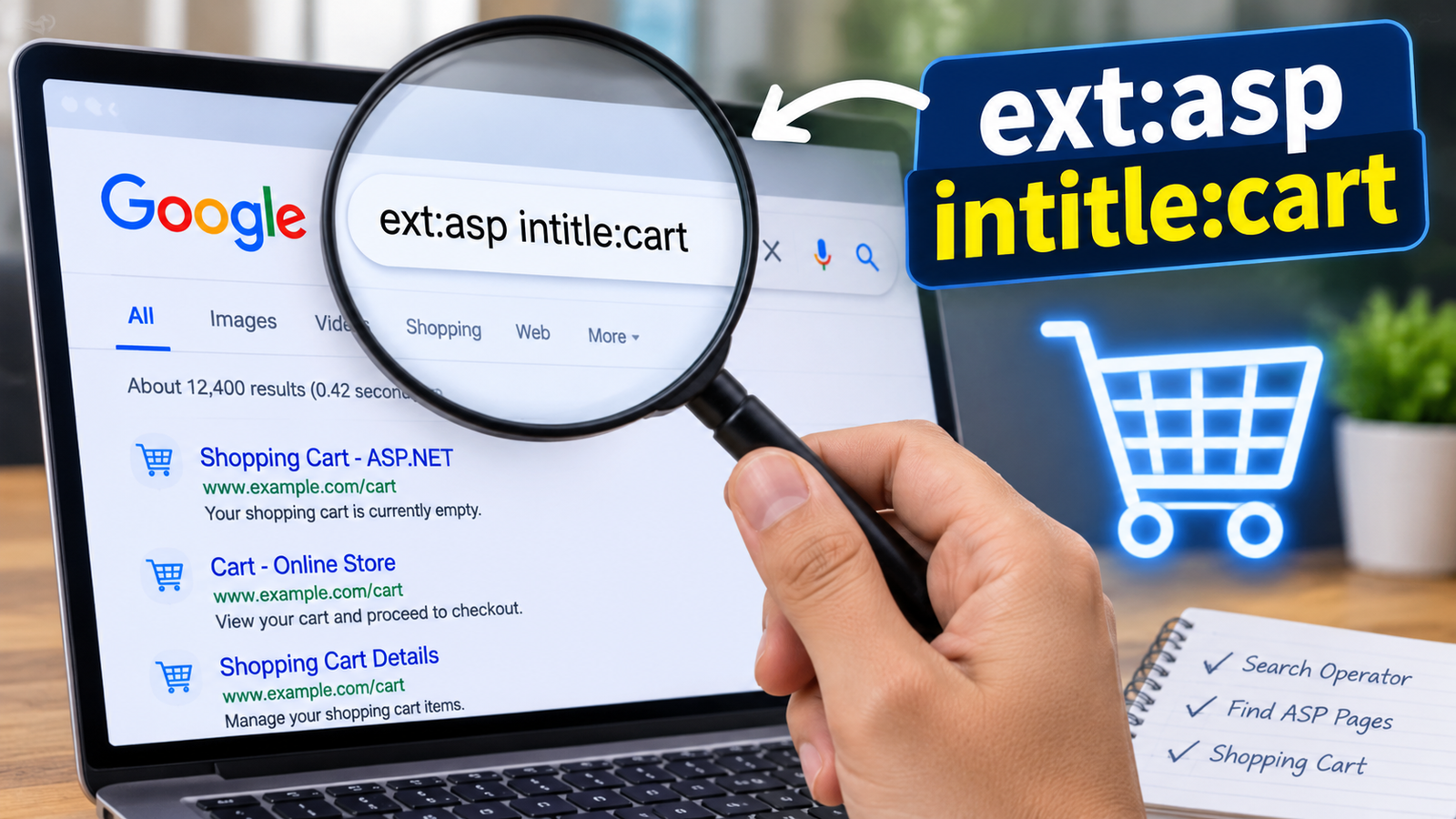
The search query ext:asp intitle:cart is an advanced search phrase intended to find webpages associated with the .asp extension that contain the word “cart” in their page title. It is commonly associated with older shopping-cart pages, legacy e-commerce websites, and search-engine research.
Understanding this query helps users learn how search operators work, recognize older web technologies, and interpret search results more accurately.
What Is ext:asp intitle:cart?
ext:asp intitle:cart is a search-engine query that combines two filtering expressions. Its purpose is to narrow search results to pages associated with ASP extensions and titles containing the word “cart.”
The query is not a website, application, or software product. It is a search phrase used to locate specific types of indexed webpages.
The term is particularly relevant to older websites that use Microsoft Active Server Pages (ASP), a technology historically used to build dynamic websites, product pages, and online shopping systems.
Understanding the Search Operators
What Does ext:asp Mean?
The ext:asp portion is intended to filter results associated with the .asp file extension. ASP stands for Active Server Pages, a Microsoft server-side technology used to generate dynamic web content.
Classic ASP websites often used .asp URLs for pages such as product listings, customer accounts, order processing, and shopping carts.
However, the extension alone does not prove which technology currently powers a website. Some sites retain old URLs after redesigns or technology migrations.
What Does intitle:cart Mean?
The intitle:cart operator focuses on the word “cart” within a webpage’s title. Page titles help search engines and visitors understand what a webpage is about.
Examples of titles that may be relevant include:
- Shopping Cart
- Your Cart
- View Cart
- Cart Summary
The title filter helps narrow results to pages related to shopping carts, although it does not guarantee that every result is an active e-commerce page.
How Does ext:asp intitle:cart Work?
When combined, the two expressions aim to narrow search results using both an extension-related condition and a title-related condition.
The query may identify older online shopping pages, legacy store interfaces, archived pages, or other ASP-related webpages with cart terminology in their titles.
Search engines do not always interpret every operator identically. Results may vary depending on the search engine, indexing status, page structure, and operator support.
Why People Search for ext:asp intitle:cart
Legacy E-Commerce Research
Older online stores sometimes rely on ASP-based applications. Researchers and web developers may investigate these pages to understand legacy e-commerce systems, URL structures, and historical website development practices.
Search Operator Learning
People interested in SEO, digital research, and search-engine techniques may use this query to learn how combining search operators changes the results.
Website Indexing Audits
Website owners can use search techniques to identify pages that may be unnecessarily visible in search results. This can help them review old shopping pages, outdated content, and duplicate URLs.
Is ext:asp intitle:cart an Official Google Search Operator?
Not entirely. Google officially documents filetype: for file-type searches, while ext: is not included in its commonly documented search operators. The ext: syntax is documented by Bing for extension-based filtering.
The intitle: operator is commonly used to search for words in webpage titles, but search operators can vary in support and behavior between search engines.
For extension-focused searches on Google, filetype:asp is a more clearly documented alternative to test. Even then, results should not be treated as a complete list of webpages.
The Relationship Between ASP and Shopping Cart Pages
Legacy web technology and modern e-commerce
ASP was widely used in earlier generations of dynamic websites. Businesses used it to build interactive features, including shopping carts, product catalogs, login pages, and checkout workflows.
Today, many e-commerce websites use newer platforms, frameworks, and URL structures. Some older ASP pages may still exist because businesses have not migrated them, while others may be inactive, redirected, or retained for compatibility.
A .asp URL is therefore a technical clue, not confirmation that a website is outdated, active, or insecure.
Search Limitations and Safety Considerations
Search results are influenced by what a search engine has crawled and indexed. A page may be missing from the results even if it exists, and some results may not accurately match the intended filters.
Finding a cart-related page does not establish that the page contains private customer information, payment details, or security vulnerabilities.
Responsible research should focus on public information and websites the researcher owns or has permission to assess. Website owners should review exposed cart, checkout, and account pages to ensure that sensitive information is protected and that private or unnecessary pages are not indexed.
Frequently Asked Questions
What does ext:asp intitle:cart mean?
It is a search query intended to locate ASP-related webpages with the word “cart” in their titles. It is commonly associated with legacy shopping-cart pages.
Is ext:asp intitle:cart a website?
No. It is a search query, not a website or online shopping platform.
What is ASP in a webpage URL?
ASP stands for Active Server Pages, a Microsoft server-side technology historically used to create dynamic webpages and web applications.
Does ext:asp intitle:cart only find shopping carts?
No. It may return tutorials, demonstrations, old pages, or unrelated content. The word “cart” in a title does not guarantee an active shopping-cart function.
Is ext:asp an officially supported Google operator?
Google documents filetype: for file-type searches. The ext: operator is not listed in Google’s general documented search operators, so its behavior should not be assumed to be consistent.
Does finding an ASP cart page mean the website is vulnerable?
No. A search result alone does not demonstrate a security weakness. Security depends on the site’s implementation, permissions, authentication, data protection, and other technical controls.
Conclusion
The query ext:asp intitle:cart is primarily a search-engine filtering expression used to explore ASP-related webpages with cart terminology in their titles. It can help with understanding search operators, researching legacy e-commerce technology, and reviewing website indexing.
Its results should be interpreted carefully because search operators are not always consistent, and indexed pages do not necessarily represent active or vulnerable websites.
Also read: Duaction
